

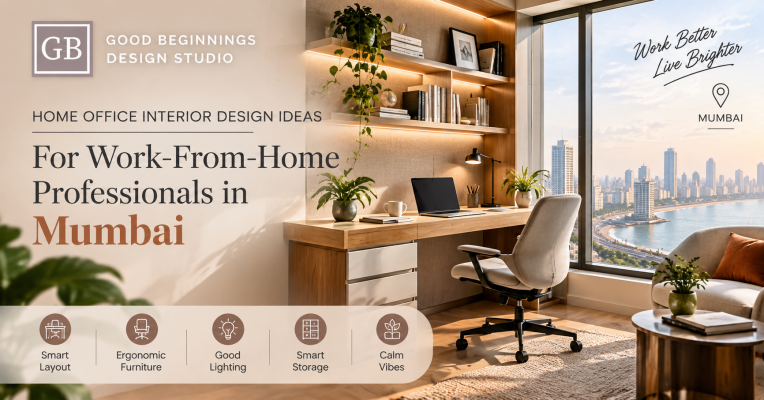
The home office has altered people’s perception of domestic interior styling. A home office is no longer just a desk in an empty corner. A place to work for professionals spending several hours working remotely must be comfortable, organised, well-lit, and visually connected to the rest of the home.
The amount of space available in a flat, a premium residence or a larger home in Mumbai may vary widely. Hence, in the case of interior designing a home office, detailed planning is a must. A smartly planned workspace will maximise available space without sacrificing the upscale look that’s needed in a luxury home.
Whether it’s ergonomic furniture, smart storage, lighting, colours, acoustic comfort, or personalised décor, everything can help support a productive home office.
The Good Beginnings Design Studio approach to home office design is to combine function and aesthetics to create a workspace that doesn’t feel like a separate office but part of the home.
Also Read: How to Style a Living Room for Everyday Comfort
The Importance of Home Office Interior Design
Your home office should work for the way you really work.
You may attend video meetings, work on a laptop, review documents, talk to clients, or work on creative projects. Day in the life of professionals: A poorly planned workspace can make these activities uncomfortable and also make the rest of the home feel cluttered.
A well-designed home office can provide:
- A committed working environment
- More organisation.
- Comfortable furniture.
- Proper lighting
- More storage space
- Professional background for video calls
- Less clutter on your eyeballs
- Clear separation of work and personal space
The design should be in line with the professional needs and the general style of the interior of the residence.
1. Pick the Perfect Location
The first step is deciding where to locate the home office.
If you can, a separate room is better, but not required. In Mumbai apartments, a home office may have to share space with a bedroom, living room, study area, or passage.
Possible locations include:
- A guest bedroom
- A dedicated study room
- A corner of a living room
- An alcove in the bedroom
- A workspace created on a balcony
- Custom-built workspace in a larger room
The place should be adequately private, have good lighting, be equipped with electrical outlets, and have a comfortable desk.
2. Purchase a Comfortable Work Desk
A home office desk is the centrepiece of a home office.
If you are shopping for a desk based on appearance alone, think about its size and height, how much storage it provides, and how well it fits in the available space.
Luxury home offices can include:
- Custom-made desks
- Desks (wood)
- Modern Minimal Desks
- Converged Workstations
- Floating desk
- Executive Desk
For smaller rooms, wall-mounted or floating desks can offer a functional workspace while minimising the visual impact.
A wider desk is better for bigger homes, as it allows space for monitors, documents, accessories, and decorative elements without feeling cramped.
3. Choose an Ergonomic Office Chair
Also, an office should be stylish and cosy.
An ergonomic chair is a good investment because work-from-home workers are able to spend a lot of hours at their desk.
Look for features like:
- Height adjustable
- Adequate back support
- Seat depth is comfortable
- Decent armrests
- Strong Foundation
- Adjustable Position
The chair should match the interior and not look totally out of place with the design of the home.
Materials and finishes can be chosen to create a more cohesive look in a luxury home office.
4. Take Advantage of Natural Light
Natural light can make a big difference in the atmosphere of a workspace.
Where possible, locate the desk near a window and away from direct glare on your computer screen.
Natural light can make a small workspace feel larger and also highlight materials such as wood, stone, textured walls, and decorative finishes.
Window treatments for homes in Mumbai should also allow for control of strong daylight when needed.
Practical options are:
- Transparent curtains
- Roller Shades
- Multi-pleated Curtains Adjustable Blinds
The aim is to have sufficient daylight to keep the screen visible and comfortable to be comfortably seen.
5. Proper Lighting in Your Home Office
Artificial lighting is also important, especially for those professionals who work early in the morning or late in the evening.
Good home offices have multiple layers of lighting.
Ambient light
Provides general illumination around the room.
Lightening
Additional light for reading and writing can be provided by a desk lamp or task lighting.
Accent Lights
Wall lights, shelf lighting, or decorative fixtures add visual interest.
Concealed LED lighting can also be built into shelving or cabinetry for a luxury home office, for an elegant feel.

6. Make a professional video call background.
The importance of a home office background has never been greater than during video meetings.
A professional background does not have to be too formal. It just needs to look clean, organised, and visually balanced.
Some good choices are:
- Texture feature wall
- Integrated bookshelves
- Minimal art piece
- Wood wall panels
- Open shelving, curated style
- House plants
- Decorative lighting, subtle
Don’t put too many objects directly behind the chair. A simple background usually looks more professional on camera.
7. Add intelligent storage.
Documents, stationery, electronics, books, cables, and accessories can quickly clutter a home office.
Smart storage keeps things neat-looking.
Think about:
- Custom cabinetry
- Closed storage units
- Floating Shelf
- Filing cabinets.
- Bookshelves
- Concealed cable compartments
- Cabinets up top
- Desk with Built-In Storage
This is especially handy in Mumbai homes that are compact, as it makes use of the wall without taking up any floor space.
8. Hiding Cables and Electronics
In modern workspaces, multiple devices are often needed.
A professional would use:
- Laptop
- Monitor
- Keyboard
- Printer
- Charging accessories
- Speakers
- Wi-Fi equipment
- Desk lighting
If cables aren’t organised properly, they can turn a nice home office into a mess.
Ideally, plan electrical points when you are finalising furniture. Cable-management channels, concealed wiring, cable trays and integrated charging points can help keep the look neater.
9. Use Colours That Support the Space
Choosing colour can change the feel of a home office.
A sophisticated workplace can be set up with a calming background of neutral colours.
Common choices are:
- Soft white, beige, taupe, soft grey, natural wood
- Light green, dark blue, and grey highlights
The colour scheme should also link with the rest of the home.
For example, if the living room is warm with wood and neutral upholstery, the home office can reflect those materials or tones to create visual continuity.
10. Add Furniture of Your Own
Custom furniture can be especially helpful when you have unusual room dimensions.
A custom home office can combine a desk, storage, shelving, and display areas into a cohesive design.
For example, a full-height unit could include:
- A central workstation
- Closed storage
- Open bookcase
- Show niches
- Storage of files
- Integrated light
This allows for a more effective use of available wall space, creating a more cohesive look.
Work-from-Home Ideas for Small Apartments in Mumbai
Having limited space doesn’t mean you have to give up functionality.
- Try these
- Use a wall-mounted desk
- Stand upright
- Opt for a compact ergonomic chair.
- Put up floating shelves.
- Build the desk as a cabinet or wardrobe
- Select sliding doors
- Choose Multi-Purpose Furniture
- Keep a light colour palette.
- Use mirrors wisely to create the illusion of space.
The best small home office designs make use of all the available spots without overpowering the room.
7 Common Home Office Design Mistakes to Avoid
Even a beautifully styled workspace can become inconvenient when you don’t plan.
Frequent mistakes include:
- Getting a desk that’s too small
- Ignoring ergonomic comfort
- Bad lighting
- Too much decorative stuff
- Lack of electrical points
- Exposed wires
- No Save
- Making a distracting background video
- Blocking out natural light
- Furniture that is too big for the room
Good planning is done before choosing furniture and decorative finishes.
Why Good Beginnings Design Studio?
Good Beginnings Design Studio is a residential interior design studio that focuses on function, aesthetics, turnkey interior execution, space planning, furniture, lighting, materials, and personalised styling.
The home office for work-from-home professionals may be designed based on the nature of work, available space, storage needs, technology needs, and the design of the residence.
The design can be customised to the home, whether a dedicated study is needed, a small workstation, a luxury executive-style home office, or an integrated workspace in another room.
The goal is to create a work environment that is aesthetically pleasing, productive, and comfortable for everyday use.
Also Read: 5 Common Interior Styling Mistakes to Avoid
Conclusion
A well-designed home office can make working from home more comfortable and organised and can add value to the overall interior of a residence.
For homeowners in Mumbai, the right strategy depends on the available space, working habits, natural light, storage needs, technology, privacy, and the existing design language of the house.
Smart storage, layered lighting, clean cable management, professional backgrounds, natural materials, and personalised décor styling services can make a small space into a functional and stylish home office.
Good Beginnings Design Studio blends these components in a thoughtful interior design process, producing home offices that satisfy professional requirements while retaining the comfort and style of contemporary home interiors.
FAQs
1. Building a Mumbai flat home office?
Ans: Begin with an assessment of space availability, natural light, privacy, storage, electrical needs, and working habits. Depending on the layout of the home, a compact workstation, built-in desk, or a separate study room can be planned.
2. What are the essential furniture items for a home office?
Ans: A desk and an ergonomic chair are the basic requirements. Depending on your work, you may also need storage cabinets, shelves, task lighting, and furniture for printers or other equipment.
3. How to create a professional video call background?
Ans: Create a clean feature wall. Add built-in shelving, artwork, wooden panels, plants, or subtle décor. Make the background clean and uncluttered.
4. How to Design a Home Office in a Small Room?
Ans: Wall-mounted desks, vertical storage, floating shelves, multi-functional furniture, and built-in cabinetry. Maintaining a visually simple design can also help the space feel larger.
5. What is the best lighting for a home office?
Ans: Generally, a combination of ambient and task lighting is useful. You can supplement artificial light with natural light. You can also add more light with a desk lamp or focused light.

Shubhangi Singh has been the creative marketing consultant for several luxury brands, with more than 18 years of experience in curating meaningful campaigns for brands like Reliance Brands, Walking Tree, Malabar, Simone, D’décor, Jio Wonderland, Zoya Jewels, Per Te Jewels, Rustomjee, Farah Ali Khan, Puma, Benetton, Vogue Wedding Show, and Foodhall X Vogue Sensorium.