

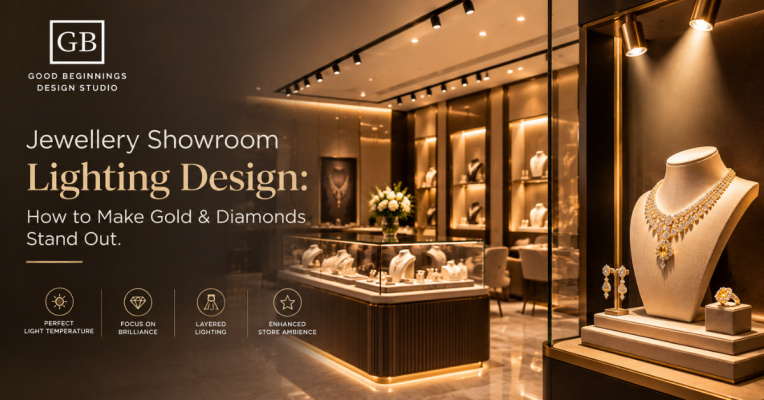
Lighting plays a huge part in how the customer views and experiences jewellery. Gold should look rich and warm, diamonds should show brilliance and sparkle, and gemstones should show their colour without looking distorted. This makes lighting one of the most important elements for a successful jewellery showroom interior.
Good lighting design in jewellery showrooms is more than just lighting the store. It highlights the collections, adds a touch of luxury, helps the comfort of customers, and makes the jewellery the visual focus of the space.
In lighting design for contemporary jewellery stores, the challenge is to strike the right balance between aesthetics, product display, décor styling services, energy efficiency, customer comfort, turnkey interior execution, and the specific characteristics of different jewellery materials.
Every space, from display counters and wall showcases to consultation tables and window displays, requires a well-thought-out lighting solution.
Also Read: Kids’ Bedroom Interior Style Ideas for Luxury Mumbai Homes
Why lighting is important in a jewellery showroom
Jewellery is also very detailed and reflective. Even an expensive piece can look flat and dull, yellowed, or hard to examine in bad light.
The right lighting can do the trick:
- Emphasise jewellery details
- Enhance natural colour in gold
- Increase diamond sparkle
- Display gemstone colours
- Make attractive exhibits
- Increase product awareness
- Lead customer centricity
- Strengthen the luxury ambiance
- Create comfortable consultation rooms
- Support general brand recognition
It’s not just about making the showroom look bright. It is a matter of using light to the best advantage.
1. Create a Layered Lighting Plan
One kind of lighting is rarely sufficient for a jewellery showroom.
A layered approach uses different lighting sources for different purposes.
Environmental light
It provides general illumination throughout the showroom and helps customers navigate the space with ease.
Display Illumination
Jewellery counters, shelves, and showcases are directly lit.
Accent Lights
Highlights can include selected collections, feature walls, architectural details, or statement pieces.
Decorative Lights
Pendant lights, chandeliers and sculptural fixtures can add character and reinforce a luxury aesthetic.
These layers are to be complementary rather than competitive.
2. Make Use of Jewellery Display Lighting
The lighting of jewellery displays is critical, as it allows customers to see fine details.
Individual pieces can be highlighted with spotlights on the showcase or on the counter.
Good display lighting should:
- Brightness adjustment
- Correct colour rendering
- Little glare
- Light uniform
- Features: in Focus
- True colour of product
Carefully position the light source so that there are no distracting reflections on glass for customers viewing the jewellery.
3. Choose the Correct Colour Temperature
The colour temperature affects how the jewellery appears.
Warm lighting can create a luxurious and inviting atmosphere, while cool lighting can create a cleaner, more contemporary look.
Depending on the type of jewellery and the brand concept, the ideal colour temperature may differ.
Gold Jewellery
Warm or neutral warm lighting will work well with the natural richness of gold.
Diamon®s
In neutral lighting, strong colour rendering can help diamonds to look bright and clear.
Coloured Gems
The lighting should show the true colour of the gemstone, without excessive warmth or distortion.
Instead of picking one colour temperature for the whole showroom, you can tweak different areas while keeping a general visual consistency.
4. Make Gold Jewellery Look Luxurious & Elegant
Gold is a strong reflector of light, so if the lighting isn’t right, it can look overly yellow or produce harsh reflections.
Consider for gold jewellery:
- Controlled warm light
- Highly colour-rendering light sources
- Display illumination focused
- Gentle ambient lighting
- Correct fixture location
The goal is to keep the natural colour of gold but make it look rich and dimensional.
Lighting should show details such as:
- Engraving, texture, polishing patterns
- Stone Settings.
- Surface Detail
5. Use the Right Diamond Showroom Lighting
Diamonds are a different story.
The sparkle of a diamond comes from how it interacts with light. Well-placed lighting can give pleasing highlights and movement in the stone.
The best diamond showroom lighting uses focused sources to create controlled points of sparkle.
But more light does not necessarily mean a better display.
Too much brightness can cause glare, while poorly placed fixtures can cause distracting reflections.
The illumination should be adequate to enable the customer to see the brilliance of the diamond and to inspect its clarity, cut and overall appearance.
6. Use High Colour Rendering Lighting
The rendering of colour is very important in jewellery retail.
A good quality light source with good colour-rendering performance can help customers view products more accurately.
This is key for:
- Gold Rubies and Diamonds
- Emeralds, sapphires, pearls
- Other coloured stones
Especially when customers compare similar products, correct colour representation is useful.

7. Prevent glare on glass displays.
Glass is commonly used in jewellery showcases, but it can also produce unwanted reflections.
Lights that are badly placed can reflect into the customer’s line of sight.
This can make it hard to see the jewellery clearly.
To reduce the glare:
- Position lights at proper angles
- Use controlled beam divergences
- Don’t put bright lights facing glass
- Use anti-reflective solutions where possible
- Test the lighting from the customer’s perspective
Lighting should always be assessed from the point of view of a person standing at the display counter.
8. Accent Lighting to Highlight Statement Pieces
Not every piece of jewellery needs the same level of attention.
Accent Lighting Can Highlight:
- New Arrivals
- Jewellery for the bride
- High-ticket items
- Unique designs
- Flagship Products
- Seasonal collections
It creates a visual hierarchy for the showroom.
Brighter or more strongly highlighted displays will naturally be seen first by customers, so accent lighting can help guide the shopping journey.
9. Design lighting display for jewellery counters
Analysis of products by customers is mostly done at counters in display areas.
Lighting should highlight the jewellery without causing discomfort to customers or sales staff.
A combination of hidden lighting and spot lighting can give a clean look.
Integrated LED lighting can be integrated into:
- Worktops
- Shelving display niches
- Vertical display units, jewellery trays
Where possible, the jewellery should be top of the list and the fixtures hidden.
10. Light Wall Displays, Handle Carefully
Wall-mounted jewellery displays can be powerful visual elements in the showroom.
You can use wall lights to create:
- Highlights: Vertical
- Collection sites
- Highlight features
- Brand claims
- Architectural depth
If you want to make certain products stand out, don’t light the whole wall evenly.
Controlled lighting can offer a more sophisticated presentation.
Common Mistakes to Avoid When Lighting a Jewellery Showroom
A showroom that has been beautifully designed can be ruined by bad lighting.
Avoid:
- Lighting too bright
- Bad quality light sources
- Bad colour rendering
- Reflection on glass
- Too many visible fittings
- Wrong beam angles
- Uneven backlight display
- Too much warm lighting; ignoring mirrors
- Same lighting for all categories of jewellery
- No testing from the customer perspective
Always test your lighting with actual jewellery and display materials before the final installation.
How to Design Lighting for a Jewellery Store
Ideally, the lighting plan is developed in conjunction with the interior design.
Step 1: Know Your Jewellery
The types of jewellery that are displayed and the way in which the different materials react to light.
Step 2: Design the Layout
Identify customer flow, display zones, consultation areas, and locations of features.
Step 3: Create Lighting Layers
Ambient, display, accent, and decorative lighting segregated.
Step 4: Pick the right fittings.
Things such as colour rendering, beam angle, brightness, size, energy efficiency, and heat output.
Step 5: Lighting check
Real jewellery, glass, mirrors, and test fixtures. Counters and wall finishes.
Step 6: Calibration of the system
Before you finally install it, you can adjust the brightness, angles, colour temperature, and position.
Why Good Beginnings Design Studio?
Good Beginnings Design Studio’s approach to jewellery interiors is to consider the relationship between space, materials, lighting, display and customer experience.
Lighting for a jewellery showroom is integrated into the overall interior, not as a separate technical element.
The lighting of each layer can be coordinated with the interior architecture – from display counters and wall showcases to consultation areas, ceilings, mirrors, window displays and feature zones.
The idea is to create a showroom in which gold looks rich, diamonds look brilliant, gemstones retain their natural character, and customers can browse the collections comfortably.”
Also Read: 5 Common Interior Styling Mistakes to Avoid
Conclusion
Effective jewellery showroom lighting is about so much more than just brightening up a store. It is about controlling how the customer views the products and experiences the space.
The right jewellery store lighting design can enhance gold, create controlled sparkle for diamonds, reveal gemstone colours, reduce glare and create a sophisticated atmosphere.
Good jewellery display lighting gives each collection the attention it deserves, and diamond showroom lighting, carefully calibrated, can help to highlight brilliance without creating too many reflections.
Lighting must be designed together with the layout, materials, display systems, mirrors and the overall branding for contemporary jewellery stores. When these elements come together, the result is a showroom that feels refined, comfortable and visually focused on the jewellery.
Good Beginnings Design Studio combines interior styling, space planning, materials, lighting and display considerations to create jewellery environments where design supports the customer experience and the products themselves.
FAQs
1. Why is lighting important in a jewellery store?
Ans: Lighting affects the perception of colour, brilliance, texture, and detail of jewellery by the customer. Good lighting can also create a premium atmosphere and draw attention to important collections.
2. What is the best light for gold jewellery?
Ans: Controlled warm or neutral warm light with good colour rendering can complement gold and reveal surface details, without making the gold look too yellow.
3. How do I light diamonds?
Ans: Attractive highlights are achieved by controlled and directed lighting, which reveals the brilliance of the diamond. Lighting must be carefully positioned so there is not too much glare and reflection.
4. Lighting for jewellery display?
Ans: Jewellery display lighting is focused lighting used inside or around showcases, counters, shelves, and display areas to highlight jewellery and improve product visibility.
5. How to reduce glare in a jewellery showroom?
Ans: Angle lights, control beam spread, avoid direct reflections into glass, and test lights from the customer’s viewing position.

Shubhangi Singh has been the creative marketing consultant for several luxury brands, with more than 18 years of experience in curating meaningful campaigns for brands like Reliance Brands, Walking Tree, Malabar, Simone, D’décor, Jio Wonderland, Zoya Jewels, Per Te Jewels, Rustomjee, Farah Ali Khan, Puma, Benetton, Vogue Wedding Show, and Foodhall X Vogue Sensorium.