

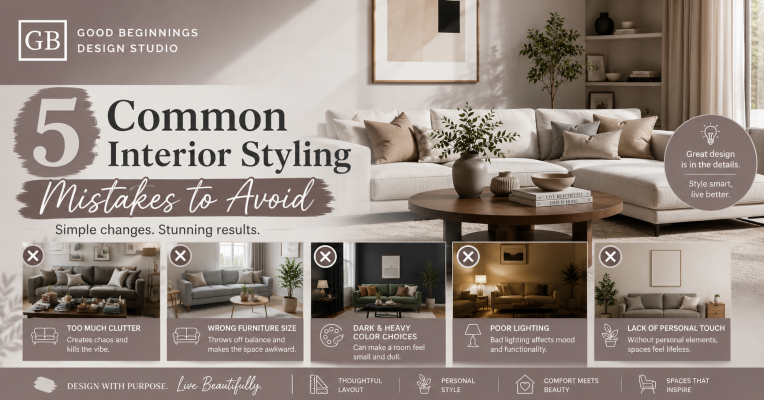
It’s more than simply choosing pretty furniture, colours, and decorative accessories in terms of interior styling. Each element should work together to create a comfortable, functional, and visually balanced space.
Even small decisions about style can affect the overall look of a room. Even a well-designed space can feel uncomfortable or cluttered if the furniture is too large, lighting is poor, there is too much decor, or the colour palette is not coordinated.
By learning the common interior styling mistakes, homeowners can make better choices for interiors that are cohesive in look and feel—and practical.
Good Beginnings Design Studio is a full-service design studio specialising in space planning, furniture, lighting, materials, colours and décor to create interiors that are a reflection of the lifestyle and needs of the homeowner.
Also Read: Top Interior Contractors in Mumbai for Premium Homes, Penthouses, and Commercial Spaces
1. Selecting Furniture That Is Too Large or Too Small
The choice of furniture should be dictated by the size and proportions of the room.
Big furniture pieces can make a small room feel cluttered, while small furniture pieces can make a large room feel empty and unbalanced.
Before selecting furniture, consider:
- Size of rooms
- Seating needs
- Walking space
- Proportions of Furniture
- Architectural features existing
- Storage needs
If the furniture is properly planned, the room will be comfortable, and the space available will be used to the best advantage.
2. Overuse of Colours and Patterns
Colour can give an interior personality, but too many unrelated colours and patterns can mean a room looks visually busy.
Generally, a balanced palette of colours is best.
A straightforward way can include:
- Main colour one
- 1-2 colours complementing
- Accent colour dash
- Balanced neutral tones
Patterns can also be introduced with rugs, cushions, curtains, artwork or upholstery. The trick is to make sure the colours and patterns work together.
Using a consistent colour scheme helps to create a more sophisticated and organised interior.
3. Using a Single Light Source
Light is important to the look and function of any room.
Depending on a single ceiling light can leave some areas too dark and make the interior feel flat.
The primary layers of lighting are:
A better way is to use layered lighting.
surrounding light
Provides general illumination for the whole room.
Task Lighting
Supports activities like reading, working, cooking, or getting ready.
Lighting Effects
Shows art, furniture, accent walls, and architectural details.
By combining different types of lighting, you can add depth and a warmer, more comfortable feeling to the interior.
4. Overdoing the Décor
Decorative accessories can make a room feel like your own, but too many things can make it look messy.
Accessories on every table, shelf, wall, and corner can make a room feel crowded.
Instead, concentrate on carefully chosen pieces such as:
- Artwork
- Vases
- Indoor plants
- Cushions
- Rugs
- Books
- Decorative objects
- Mirrors
All decorative objects should have a purpose in the general composition.
Sometimes a few well-selected accessories can be more visually effective than a large collection of unrelated accessories.
5. Function over form
One of the biggest mistakes interior stylists make is only thinking about how a room looks, not how it will be used.
Still, a beautiful interior must work for everyday activities.
Consider questions like:
- Is there enough seat space?
- Are people able to move around the room comfortably?
- Is storage readily available?
- Is the lighting right for day-to-day activities?
- Is furniture able to be comfortable?
- Is the decor easy to maintain?
Interior styling should enhance daily living, not make the space difficult to use.

Other Interior Design Considerations
The above five mistakes are common, but there are some other factors which should also be kept in mind while going through the styling process.
Ignoring the natural light in the room
Natural light can alter the appearance of colours, materials and finishes. Arrange your furniture and decor according to your available light.
Choosing Colours Regardless of Materials
The colours of the walls should harmonise with flooring, furniture, wood finishes, fabrics and other materials.
Obstructing Windows and Walkways
Large furniture should not block natural light or unnecessarily hinder movement around the room.
Choosing Décor Without a Design Direction
While individual accessories can be attractive, they can also appear disjointed if they don’t relate to the overall style of the interior.
How to Avoid Mistakes in Interior Design
A lot of common problems can be avoided with thoughtful styling.
Begin With:
- Measure the room precisely.
- A clean design style
- A good colour scheme.
- Furniture with a function
- Good illumination
- Feasible storage.
- Curated decor
With these basics in place, finishing elements can be added to complete the interior.
Why Professional Interior Styling Helps
A professional interior stylist will bring all of the elements of a room together to create one design concept.
An experienced interior design studio can help to coordinate:
- Furniture Space Planning
- Choice of colour
- Lightweight Materials
- Wall finishes
- Stock.
- Soft furniture
- Ornamentation
This system can also help with avoiding mismatched furniture, too much decoration, bad layouts, and unbalanced colour schemes.
Why Good Beginnings Design Studio?
Good Beginnings Design Studio is an interior design and styling service that creates stylish and functional living spaces for the home.
The studio’s work covers luxury residential interiors, space planning, custom furniture, modular kitchen design, lighting consultation, décor styling services, wardrobe design, wall finishes and turnkey interior execution.
Each project can be tailored to the homeowner’s lifestyle, preferences, available space and overall design vision.
It focuses on designing interiors that are in harmony with furniture, colours, materials, lighting and décor.
Also Read: Modern House Interior Colour Combinations That Create Elegant and Timeless Living Spaces
Conclusion
Good interior styling requires a balance between aesthetics and function. Avoiding common mistakes such as choosing the wrong size furniture, too many colours, limited lighting, too much décor, and ignoring everyday functionality can greatly improve the final result.
The best interiors aren’t just pretty. Comfortable, organised, practical and adapted to the people who use them.
With careful planning and professional interior design, each element can work together to create a cohesive and inviting space.
Good Beginnings Design Studio combines space planning with furniture, lighting, materials and décor to create interiors designed for everyday comfort and lasting visual appeal.
FAQs
1. What are the common mistakes in interior styling?
Ans. Common mistakes include picking furniture that is too big or too small for the room, using too many colours or patterns, having only one light source, adding too much décor, and focusing on looks rather than function.
2. How do I know if my furniture is too big for a room?
Ans. Size of the room, walkways, Door openings, and space between furniture. Furniture should be comfortable to sit on and not get in the way.
3. How many colours should I use in an interior?
Ans: Visual balance can be achieved with simplicity in one dominant colour, complementary shades, neutral tones, and one accent colour.
4. Why layer lighting? What’s the benefit?
Ans: Layered lighting gives general illumination and can be used for particular activities and to highlight key design features. It can make a room feel more cosy and visually balanced.
5. How can I keep my room from getting messy?
Ans. Choose decor wisely. Keep surfaces and pathways clear. Use functional storage. Do not add accessories just to fill empty spaces.

Shubhangi Singh has been the creative marketing consultant for several luxury brands, with more than 18 years of experience in curating meaningful campaigns for brands like Reliance Brands, Walking Tree, Malabar, Simone, D’décor, Jio Wonderland, Zoya Jewels, Per Te Jewels, Rustomjee, Farah Ali Khan, Puma, Benetton, Vogue Wedding Show, and Foodhall X Vogue Sensorium.